The History of the Christmas Album: The First Format War (1890-1925)
Today is our first post of 2026 and the second installment in our History of the Christmas Album Series: The First Format War.
In the last History of the Christmas Album post, we covered the rise and fall of sheet music from the mid-1800’s, on through the 1910’s.
We’ll pick up where we left off last time, or, more accurately, slightly before where we left off, and look at the period starting with the first commercial sound recordings in the late 1880’s and ending with the industry adoption of the 78rpm record in 1925.
This era saw a rapid evolution in sound recording technology, spurred on by the battle between Thomas Edison’s wax cylinders and Emile Berliner’s shellac discs to dominate the home market.
As we discussed in part one, sheet music, propelled by the new marketing and distribution techniques of Tin Pan Alley and the availability of cheaper, mass-produced pianos in the late 1800’s, experienced peak sales shortly after the turn of the 20th century. But, within two decades, the medium was in a free fall, largely due to the advent of radio and the growing popularity of recorded music.
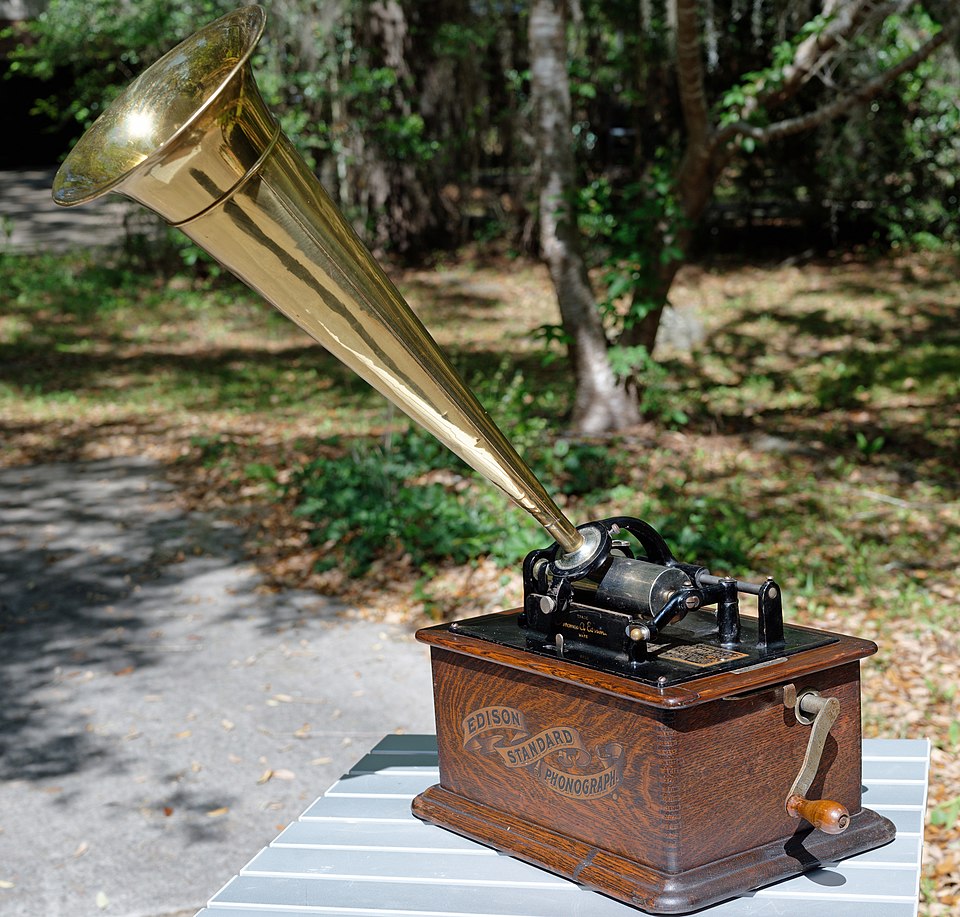
Thomas Edison introduced the phonograph in 1877. And while we could easily fill an entire episode on that topic alone, we’re going to try to stick to just the highlights.
Soon after Edison unveiled his sound recording technology, Alexander Graham Bell’s Volta Laboratory introduced the graphophone. Bell’s device was based directly on Edison’s design, but the graphophone had several improvements, including a move from using tin cylinders to wax-coated cardboard tubes.
Neither the phonograph nor graphophone was originally envisioned as a music playback device. They were designed to be dictation machines, used by businesses to capture, store and replay audio, replacing the need for stenographers.
Edison quickly moved on from the phonography to other inventions, allowing a business made name Jesse Lippincott to purchase his Speaking Phonograph Company and exclusive rights to his patents. Lippincott also purchased a stake in the American Graphophone company and sales rights to the Graphophone. Through these acquisitions, Lippincott created the North American Phonograph Company and a network of offices to lease and sale both phonographs and graphophones as dictation machines.
The use never caught on, and Lippincott’s company would go bankrupt a few years later. But, during that time, an alternate use developed for phonographs and graphophones: the playback of pre-recorded music. This use also rekindled Edison’s interest in his own invention, and, in 1888, he released the “Perfected Phonograph” through his new company, Edison Records.
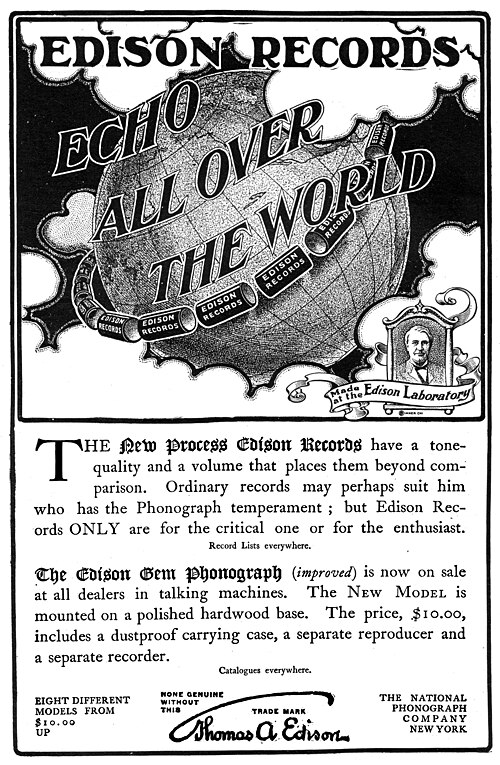
Building on Bell’s improvement to his original phonograph, the following year, Edison Records began releasing its own wax entertainment cylinders. These early pre-recorded cylinders were laborious to produce. Performances had to either be captured live, etched into cylinders in real-time or duplicated by playing a recording on one phonograph while other machines, connected by tubes, recorded copies of it. It was like a very early version of using two VCRs to rent and duplicate movies. Not that any of us ever did that…
Between the cost of cylinder production, their incredibly short lifespan (initially as few as 20 plays) and the high cost of the phonograph itself, devices were sold almost exclusively to nickelodeons. These were businesses where patrons could pay a small fee for entertainment. This ranged from short, silent films to live acts to the chance to witness the technological marvel of recorded sound and listen to music on a player.
Edison’s technology continued to advance quickly. He refined the ability to mass-produce cylinders from a single “master” recording and the cylinder’s composition itself was improved, moving to a harder wax formula that could withstand hundreds of plays, not tens. These advances, along with the development of much cheaper phonograph devices that were targeted specifically for in-home use, ushered in the era of sound recordings in the late 1890’s, mirroring the rise of pianos and sheet music a few decades earlier. But it wasn’t just Edison’s wax cylinders that people were buying.
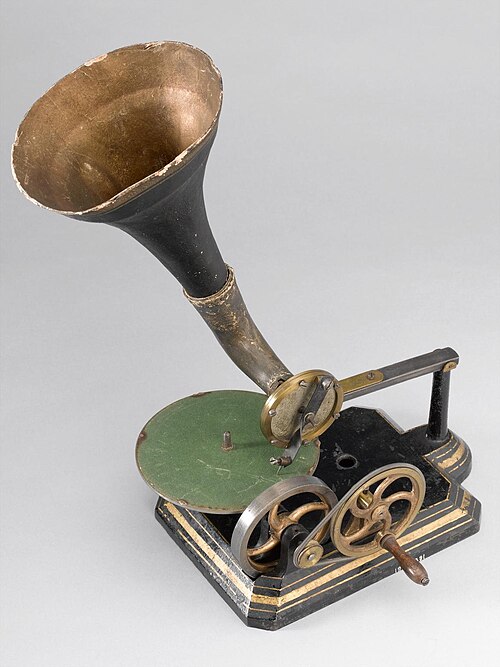
Around the same time Edison was pivoting his interest back to the phonograph, Emile Berliner was introducing the gramophone. The gramophone leveraged technology similar to the phonograph, but instead of wax cylinders it played sound recordings from shellac discs.
Though Berliner’s shellac discs held less audio than Edison’s wax cylinders, consumers immediately noticed several other advantages.
Being flat, gramophone discs were much easier to store than individually boxed cylinders. They were also generally more durable, and, unlike wax cylinders, which were completely covered with the recording surface, discs had a bit of unused room at their centers. The perfect spot for a label.
This might seem trivial, but it was quite a big deal. Initially, cylinders didn’t contain any information about the performance that was etched into the wax. That changed over time, first with information etched into the dead wax (the area of the cylinder that didn’t contain music), then with printed information on the edge of the cylinder.
But, in the earlier days of the format war, if your cylinder was separated from its box, you no longer knew who and what was on it, which is why they often included a spoken introduction of the artist and song.
There was also the ability to record on both sides of the disc. That was kind of a big deal as well, allowing for two unique tracks on a single piece of media.
All these consumer advantages, paired with easier mass production of media and mechanically simpler, less expensive playback devices gave the shellac disc a clear lead.
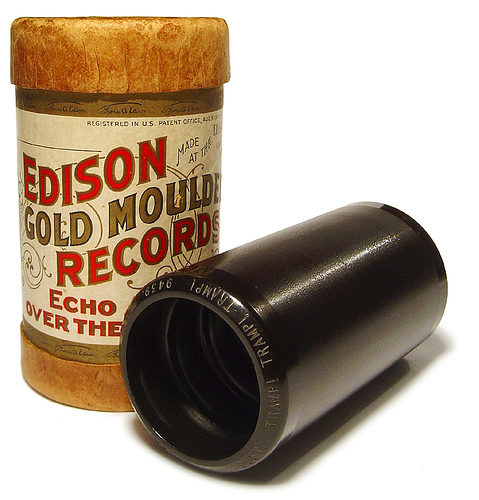
Edison did continue to improve the wax cylinder during this time, first with the “gold moulded” process to create higher quality, mass-produced media and then later with his line of superior “Blue Amberol” cylinders that swapped the wax for celluloid, a durable early plastic. But, seeing the writing on the wall, in 1912 Edison pivoted from the cylinder and released his own disc format, the Diamond Disc Record.
Edison’s discs used the same vertical groove format as his wax cylinders, with the sound produced by the needle moving up and down in the groove. This gave his discs a longer play time and superior audio quality compared to all other disc manufacturers who used lateral groove discs, where the sound is made by the needle moving back and forth between the left and right sides of the groove.
This also meant that Diamond Discs were expensive and could only be played on proprietary, equally expensive Diamond Disc phonographs, which themselves were incompatible with discs from other manufacturers. This was Edison attempting a walled garden a hundred years before Apple, but without the massive base of cult-like fanboys needed to pull it off successfully.
That same year, Columbia Records, one of the largest independent producers of both cylinders and discs at the time, abandoned Edison’s platform to focus solely on gramophone discs.
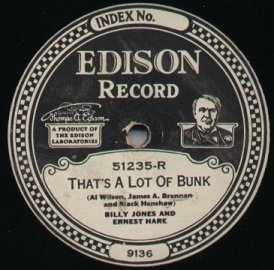
Edison continued releasing both discs and cylinders until 1929, but from 1915 onward, all new releases were recorded for disc, with the cylinders being merely dubs, produced for customer who owned the now “older” cylinder phonograph players. This is similar to the early 2000s when record labels were still releasing cassettes of their tops artists, but they were clearly an afterthought. The first format war was over, and the winner was Berliner’s lateral cut shellac discs.
This coalescence of the sound recording industry around a single format also helped create and solidify a standard. The earliest discs were recorded at speeds varying from 60 to 130 rpms, though most fell somewhere between 60 and 90 rpms. Many players employed speed regulators or governors to allow listeners to adjust the revolutions of each disc to attempt to match the recording speed. In 1912, the Gramophone Company chose 78rpms as their recording standard and started producing new players that advertised this standard and had the governors pre-set to the speed.
By 1925, the 78rpm standard was being adopted by all the major record companies as their recording and playback speed. Wax cylinders had been dying for over a decade, but I consider 1925 the true end of the format war since it marks the point where the recording industry as a whole settled on both a single format and a single recording standard.
Though it wouldn’t become commonplace for another two decades and was created mainly to distinguish the shellac discs of this period from the vinyl LP’s and 45’s that would come to replace them, this standardization is what led to the term “78”.
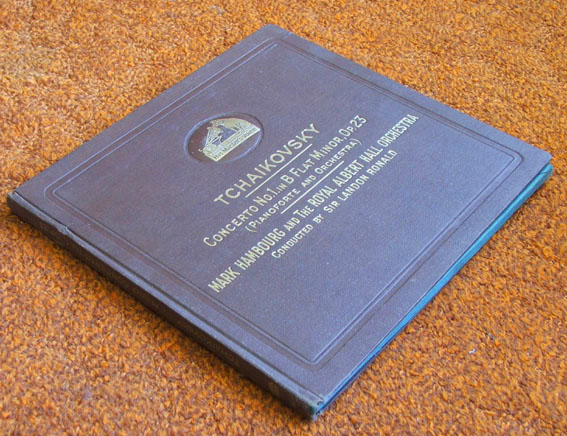
Another important term that started appearing around this time was the “Album”.
As Alonso and I touched on briefly in his Merry Mixtape episode back in October, unlike wax cylinders, which were sold in boxes, early discs were largely sold in paper sleeves. As the format gained in popularity, photo album manufacturers saw an opportunity and started producing “record albums” to house and protect these discs. This was the great-great grandfather to those 300-disc Caselogic CD binders we all had in the late ’90s.
Of course, record companies quickly jumped on the trend themselves and started releasing multi-disc sets in their own bound jackets around the same time.
Now that we’ve looked at the battle of early sound recording formats, we can see if any Christmas recordings were being produced during this time.
The short answer is yes, and a lot.
An instrumental version of “Jingle Bells”, performed by banjoist Will Lyle is believed to be the first recorded Christmas song. No known copies exist, but a 1898 wax cylinder of the Edison Male Quartet performing “Sleigh Ride Party”, a variation of “Jingle Bells” has survived.
By the turn of the century all the major recording companies, including Edison, Victor, Zonophone and Columbia, were producing Christmas recordings.
The University of California Santa Barbara is home to the Discography of American Historical Recordings and, using their online search tool, I was able to find Christmas recordings in their archive all the way back to 1901.
Popular early recordings included “Joy to the World”, “Silent Night”, “O’ Tannenbaum”, “Adeste Fidelis”, “Auld Lang Syne” and the aforementioned “Jingle Bells”…or “Sleigh Ride Party”…or “Sleighing Party” depending on the recording.
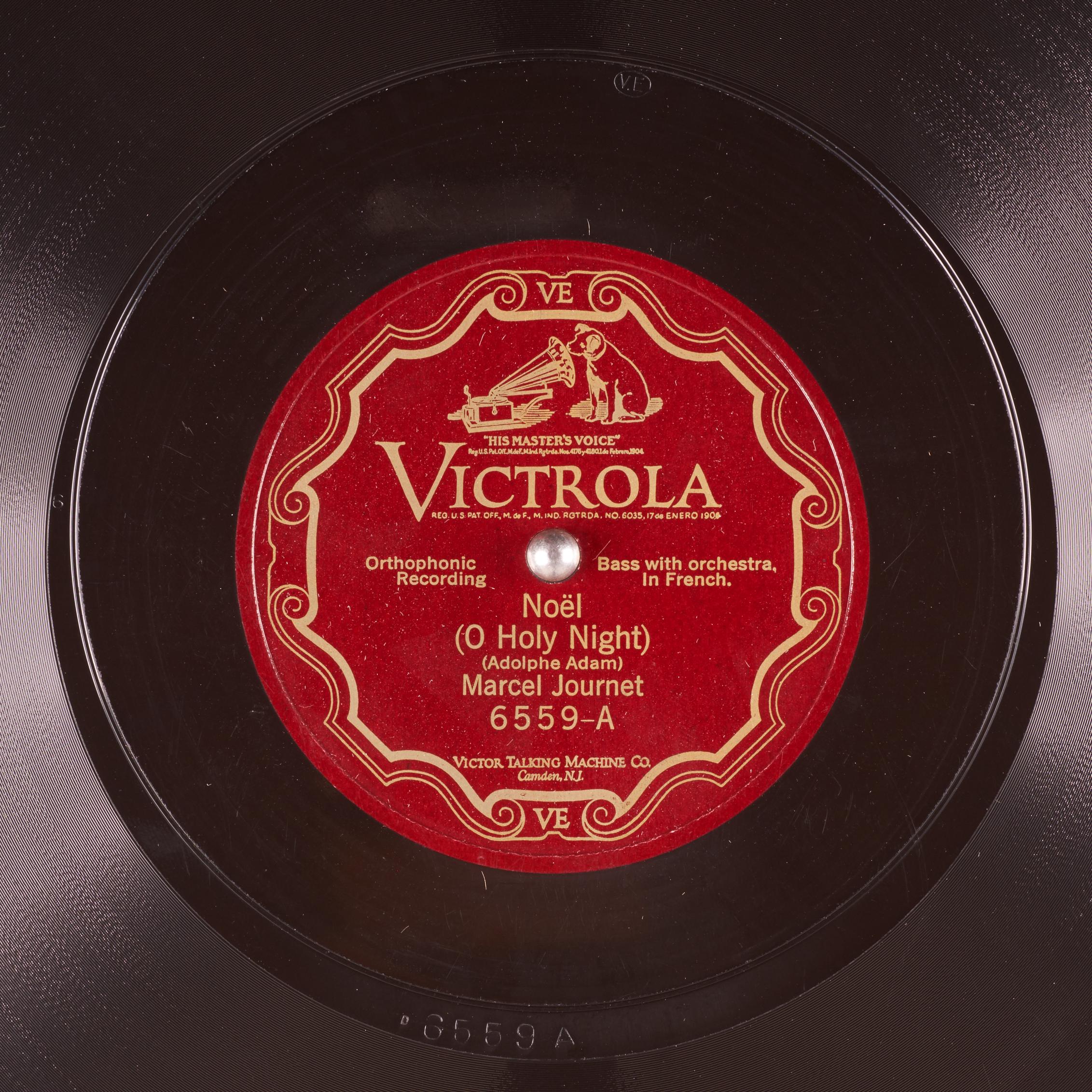
Another great resource for early Christmas sound recordings (or early sound recordings of any variety), is Archive.org’s The Great 78 Project, which now contains over 180,000 preserved sound recordings.
One interesting difference between this period and the one the preceded it: while there were plenty of Christmas recordings during this time, there wasn’t a lot of new Christmas music being created.
I’m not sure if this was due to the shift from sheet music to sound recordings disincentivizing the creation of new Christmas music in favor or recording existing songs or if it was more a result of the general focus at the time on traditional hymns and carols, but it was hard to find new Christmas music between 1900 and 1925.
It’s also possible that was in fact new Christmas music, but none of it had a lasting cultural impact like the music of the periods immediately preceding and following it.
That was the answer Google’s AI gave me, though I think there are some flaws with it. As we’ve discussed, the first two decades of the century saw the proliferation of sound recordings. If there was truly a forgotten treasure trove of Christmas music from this time, there would be some record of it. Pun intended.
But I was hard pressed to find anything. In fact, the only new Christmas song I could definitively pin to this period, is 1909’s “Christmas-Time Seems Years and Years Away”, by Irving Berlin and Ted Snyder. Outside of that, we have to get a bit more creative.
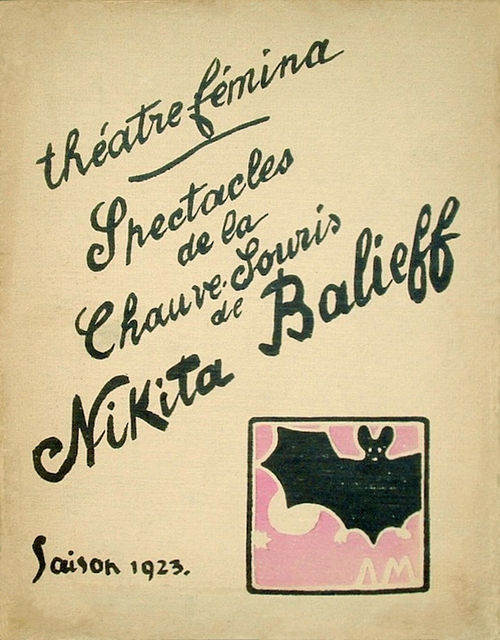
There was “The Parade of the Tin Soldiers”, composed by Leon Jessel in 1897. But it wasn’t co-opted by the holiday season until Nikita Balieff’s vaudeville revue The Bat hit Broadway in 1922.
Balieff’s show included a version of the song retitled to the much-more-Christmas-familiar “Parade of the Wooden Soldiers”. This version became wildly popular and led to several hit recordings throughout the 1920’s, including versions by Carl Fenton’s Orchestra, The Vincent Lopez Orchestra and Paul Whiteman and his Orchestra. The track became a bonafied holiday song when the Radio City Rockettes began including a version in their Christmas Spectacular in 1933.
Similarly, the songs “Toyland” and “March of the Toys”, both from Victor Herbert’s 1903 operetta, “Babes in Toyland”, didn’t have a strong Christmas association out of the gate. It wasn’t until the 1950’s that these songs started popping up on Christmas albums, including Jo Stafford’s Happy Holiday in 1955 and the 1957 album Christmas Music by the previously mentioned Vincent Lopez Orchestra.
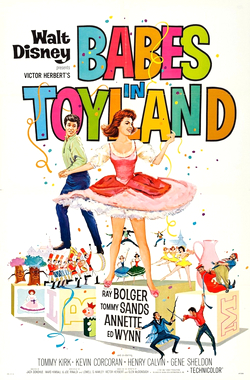
And we can’t not mention Disney’s 1961 film adaptation. For the film, Disney not only did a major rewrite to Herbert’s plot, but also tinkered with the lyrics and tempo of many of the songs to better fit the movie’s more upbeat, light-hearted tone. The final product was a far cry from Herbert’s original operetta, but Disney’s use of Christmas imagery cemented the music’s association with the holiday season.
And then there’s “Carol of the Bells”…sort of.
The song started as “Shchedryk”, a Ukrainian Shchedrivka, or New Year celebration song, composed by Mykola Leontovych in the early 1900’s and based on a traditional Ukrainian folk chant.
The song tells the story of swallow that flies into a home to inform a family of their prosperous new year. And if you’re thinking that doesn’t sound at all like “Carol of the Bells”, well, you’re right!
After touring for a couple of year, the Ukrainian National Chorus brought the song to New York City in October 1922, where they performed it at Carnegie Hall and recorded it for Brunswick Records. After this performance, the song was adapted by Peter J. Wilhousky.
Wilhousky rearranged Leontovych’s melody for an orchestra and changed the lyrics from a song about an auspicious bird to the now familiar lyrics about bells ringing because to him, the melody sounded like handbells. Wilhousky’s “Carol of the Bells” because extremely popular, in no small part because of his role as arranger for the NBC Symphony Orchestra which allowed him to get his song in front of a large audience.
But that all happened around 1936, a full decade after the period we’re discussing.
And that’s it, that’s all I could find.
Beyond sound recordings, Christmas sheet music was still being sold, albeit less each year. And Christmas songs were starting to appear on the radio.
While it was nothing like the modern stations that do a full format flip to Christmas sometime in November (that didn’t start happening until the very end of the 1980’s), as soon as commercial licensed stations came on the air, around 1920, you could find familiar holiday tunes around Christmastime. This would have been a mix of both sound recordings and live performances, as most of the large early broadcasters employed their own live orchestras.
And with that, we’ll end part two of our The History of the Christmas Album series. In part three we’ll look at how the introduction of the electric microphone ushered in the next advance in recorded music and explore the heyday of the 78, from the 1920’s to World War II.
Cheers and Happy New Year!